Article · Uranus
Uranus: Seeing the Difference
Uranus in life, history and the twelve signs
Pavel Medvedev · Published:

At a meeting, someone says, “It's always the same people doing everything. The rest never help.” A rota lies on the table. A few names really do appear more often than the others. The numbers seem to have settled the argument.
Then one participant asks, “And who puts this list together? Who remembers when supplies are running out, finds cover for someone who is ill, answers messages at night?” Nobody has recorded those hours. The conversation about help changes unexpectedly: until now they counted attendance on a shift; now they notice the work of making the shifts possible.
Nobody has staged a spectacular rebellion. No new machine has been invented. Yet the old distinction no longer holds everything that is happening. In the reading proposed here, Uranus helps us look for such turns: on what basis did we regard things as alike or different, and what now lets us compare them more accurately?
Sometimes we need to separate things previously confused. Sometimes, instead, we find a shared difficulty behind cases that look unlike each other. The novelty lies in the way of distinguishing itself, not merely in the surprise of someone hearing an explanation already familiar to others.
A planet first mistaken for something else
Uranus was known to observers before it was recognised as a planet: they had recorded it among the stars. In March 1781, William Herschel noticed an unusual object and initially took it for a comet. Further observations and work on its orbit led to a different conclusion.
The story contains a turn remarkably suited to our subject. Seeing an object and understanding what kind of thing it is proved to be separate events. The sky did not have to change for the human map of the sky to change.
The discovery does not, of course, establish an astrological meaning in itself. It offers an image with which modern thought can work. Unlike the Sun and Saturn, Uranus was not one of the seven lights on which Ptolemy's astrology was based. Its meanings familiar to readers today cannot simply be carried back into antiquity.
In the teaching materials of Pavel Andreev's school, Uranus appears beside freedom, paradox, insight and the capacity to see oneself from outside. An image emerges of a mind that does not fit the familiar compartments. It can be an inspiring experience: the question turns out to allow an answer nobody at the table had considered.
But being unusual does not make a view accurate. Someone can surprise everyone and clarify nothing. Bold new names can be attached to an old division while the old mistake stays in place. After an insight, it is therefore useful to ask: which cases will now separate, which will come closer, and why will this help us understand the next case rather than merely retell the last one impressively?
The Fool at the edge of a familiar road
On the Fool card, a traveller carries a small bundle, holds a flower and looks upwards. A dog is nearby; beneath the traveller's feet is the edge of a cliff. The image contains both openness and something openness cannot remove: the road still has features worth noticing.
In the author's pairing, the Fool helps us step outside the certainty that every name is already final. We can question the most familiar things: why do we count this as success, why do we call these people alike, why choose only between the two answers we have been offered?
Yet the card does not oblige us to celebrate carelessness. A fresh view becomes more useful when it can meet what contradicts it. Sometimes another path really does open for the traveller. Sometimes the traveller has merely stopped looking at the ground. These stories should not be joined under the single flattering word “freedom.”
Two kinds of silence in Marina's lesson
Let us imagine another episode in the life of Marina, the pianist familiar from the articles on Jupiter and Neptune. Two students remain silent after her question. She used to regard such silence as one and the same difficulty: they had not understood the explanation.
But one cannot hear the difference between two phrases. The other hears it perfectly and is simply afraid to speak before an older student. Repeating the same explanation to both means helping one while increasing the other's tension.
Marina begins distinguishing a lack of understanding from the absence of a safe opportunity to answer. For the first student she seeks a clearer musical example. For the second she changes the order of the conversation. If a colleague already uses this distinction and passes it on to her, this is primarily the learning familiar from Mercury. If a new basis for considering similar cases has emerged in her own work, the question of Uranus becomes appropriate.
The students need not immediately play better. Seeing a difference, explaining it and changing a lesson are connected but separate achievements. Naming them in turn does not devalue fresh thought. It makes clearer what it has opened up and what still needs to be achieved.
Twelve signs: twelve familiar divisions questioned
In each sign, we will look at what people first regarded as similar and what they later began to distinguish. Sometimes the movement will go the other way: cases will prove closer than familiar labels suggested. This is an inquiry into situations, not a demand that a person constantly be original.
Uranus in Aries

The neighbours argue over who first started the courtyard workshop. One wrote in the group chat, another found tables, a third obtained the key. Each speaks of the beginning as if it were a single event that could belong to only one person.
Then Vera suggests distinguishing the beginning of the conversation, the beginning of preparations and the arrival of actual access to a place. The argument changes shape. Recognising one participant no longer requires taking another's achievement away: they were speaking about different first steps.
The new names are useful because they allow the next project to be considered differently. A sent invitation no longer counts as evidence that a room is ready. Receiving the key does not give its holder credit for the original idea. Had Vera merely reminded everyone of a sequence they already accepted, she would have restored familiar understanding. Here the group is reorganising its very comparison of beginnings for the first time.
The Emperor beside Uranus helps ask where we have drawn an event's boundaries too crudely. They still need to agree on roles afterwards. The distinction itself does not change who has the right to issue keys, nor replace a Plutonian reorganisation of power.
Uranus in Taurus

At the workshop, furniture is chosen by its weight and the thickness of its wood: heavy looks reliable. Yet one massive table rocks on an uneven floor, while a light one with adjustable feet stands firmly. The familiar impression ceases to explain an object's fitness for use.
The maker begins comparing supports, joints and intended loads. Some objects that look unlike each other prove close in their behaviour, while two almost identical tables differ substantially. This is not an invitation to regard lightness as always better. The new view asks what allows an object to hold steady in this particular use.
If the check is already described in a textbook and a student learns it, we are seeing knowledge being passed on. The Uranian question arises where the previous basis of comparison changes within the work under consideration. A student's surprise can accompany either case and does not distinguish them by itself.
The Hierophant encounters a question put to an accustomed craft rule. A good tradition can accommodate a refinement. Deciding that a particular table has been tested and is ready to hand over belongs to Saturn: a new understanding of reliability still needs to be applied to this object.
Uranus in Gemini

Two people say, “I'll think about it.” One is asking for time to make a real choice. The other is politely declining and hopes the subject will not return. Their interlocutor mistakes identical words for identical promises and waits a week for both.
Later, that person learns to distinguish what a remark does in a particular conversation: postpones a decision, closes a discussion, requests more information. Different expressions can prove close in what they do, while identical ones diverge. Comparing vocabulary alone is no longer enough.
Yet we cannot assign a hidden refusal to everyone's “I'll think about it.” The new distinction is useful only alongside checking: we can ask whether to return to the question, and when. Otherwise subtlety becomes overconfident mind-reading.
The Lovers recall that separate people meet in conversation. Mercury helps recover the particular meaning of what is said between them. Uranus in our story concerns the revision of the previous basis for comparing remarks. One discovery can support many future conversations, but it does not excuse us from attending to each person.
Uranus in Cancer

A family counts the hours spent caring for a relative. The brother was there for three hours, the sister for three. On paper, their participation is equal. But the sister also remembers the shopping, arranges journeys, finds replacements and explains to each person what has changed since yesterday.
Once this work is noticed, the old equality is no longer obvious. The family begins distinguishing being present from organising continuous care. Not because one always matters more, but because both occupy a life and take energy.
The Chariot helps us see what allows separate efforts to move together at all. Previously unnoticed tasks become comparable with visible visits. Yet the new view has not redistributed the burden. Everyone may acknowledge the sister and leave her doing the same work. Changing actual duties will require separate action and possibly a revision of family dependencies.
It also matters not to turn the discovery into a new crude label: “The organiser is the only one who really cares.” The person at the bedside is doing necessary work of their own. A refinement is useful when it lets us see more distinctions, rather than simply making a different participant invisible.
Uranus in Leo

At an exhibition, students' work is initially divided into original and imitative according to outward style. An unusual colour seems to indicate a personal voice; a familiar composition, copying. Yet one daring painting almost entirely repeats a fashionable example, while in a quiet still life a student has independently solved a difficult problem of light.
The teacher suggests examining where the significant decisions came from. The division changes: a striking appearance no longer guarantees authorship, and a familiar genre does not rule it out. Checking this requires listening to an account of the work, looking at sketches and following the revisions.
Strength beside Uranus helps someone bear the loss of a flattering but oversimple assessment. The new view may hurt a student previously praised for being different. It frees another from having to perform strangeness for recognition.
The Sun concerns the personal contribution in each painting. Uranus here concerns how the teacher learned to distinguish a contribution from its outward signs. The paintings may have existed before. Their actual origins have not changed retrospectively; the way they are compared has changed.
Uranus in Virgo

Two drawers that are hard to open arrive at the workshop. At first the maker intends to plane their runners in the same way. Then he notices that the wood has swollen in one, while the entire cabinet around the other is out of square. Similar complaints conceal different causes, so the same repair would damage the second object.
In another case, a drawer and a cupboard door behave differently, yet both difficulties come from furniture standing unevenly. Different complaints now come together under a common check. The movement runs both ways: similar things are separated, dissimilar ones connected.
The Hermit supports the patient attention without which a new distinction would remain a guess. If the maker is simply applying a rule already known to him, there is no need to declare every inspection a Uranian discovery. The important turn here is abandoning the old comparison based only on the visible symptom.
After understanding, the cabinet still needs levelling or the part repairing. Uranus does not replace Mars. Nor does one successful conjecture allow all future cases to be counted as checked. A good distinction helps us ask precise questions; it does not grant a lifetime licence to stop looking closely.
Uranus in Libra

Two workshop members each receive three hours' access to the room. The allocation looks equal. Yet one gets time after work; the other's slot falls during a compulsory shift. Equal quantities do not give equal opportunities to use them.
At the meeting, people begin distinguishing time on the schedule from time actually available to a person. Another way of comparing offers appears: can someone really come, is the equipment available, do they have to pay for a journey to get only a few minutes' work? An equal number ceases to be the only answer to the question of equality.
Justice beside Uranus helps refine the measure of comparison. It is not a ready-made prescription that everyone must always receive a different number of hours. Previously overlooked circumstances are now visible; a fair decision still needs discussion.
If the schedule remains unchanged, a new understanding may nevertheless have emerged. But access should not be declared changed. Pluto concerns an actual revision of the arrangement on which access depends. Seeing unfairness and gaining the power to change it are different, though often connected, events.
Uranus in Scorpio
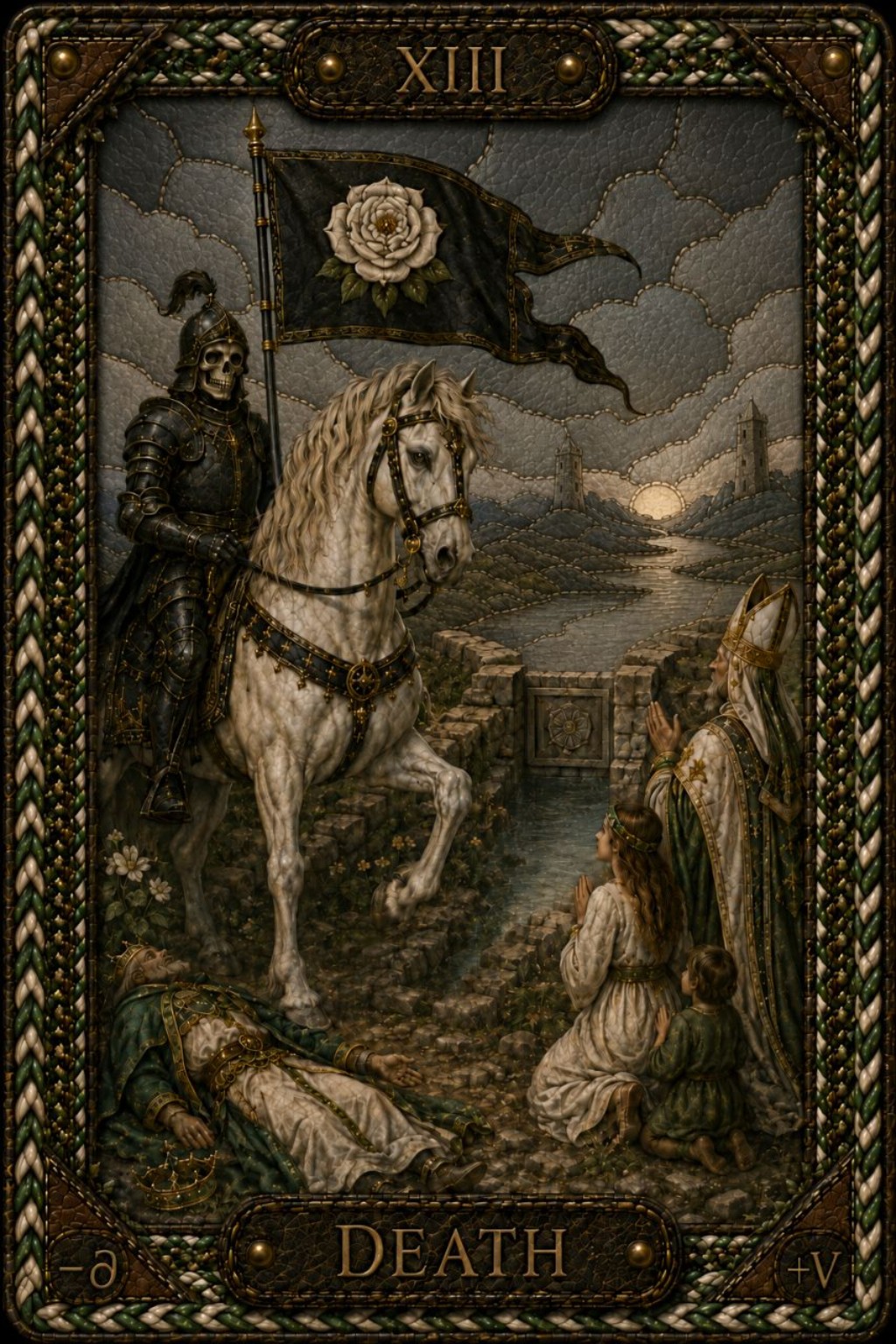
A closed club resumes work under a new name. Its former director is now a consultant, and the contract is called a partnership agreement. Everyone welcomes the new life. Then it emerges that the consultant retains the sole right to cancel gatherings and control the shared funds.
One participant proposes comparing old and new by asking whose consent the next action requires. Under this examination, a conspicuous renaming proves less substantial than a quiet transfer of signing authority in another organisation.
Death beside Uranus lets us ask what has actually ended. Sometimes the sign has disappeared while the operative dependency continues. Sometimes the outer shell remains while the former arrangement no longer determines life. A division based on visible rupture gives way to attention to what continues to operate.
This change in understanding does not yet remove the consultant's rights. It allows the situation to be named more accurately. There is no need to dismiss that step for failing to produce an immediate victory. But a clear diagnosis of dependency must not be presented as liberation already achieved.
Uranus in Sagittarius

Two people are learning languages. One moves quickly from course to course; the other spends a year reading one short novel with a teacher. Counting completed programmes makes the first appear much further ahead.
Then they explain why they are learning. One needs short conversations while travelling; the other wants to read family letters without an intermediary. Comparing the length of their course lists begins to conceal more than it explains. Now people ask what each path leads to and what the learner can actually do.
Temperance connects different steps into movement without requiring one ladder of success. Two unlike paths can lead to a similar possibility, while identical exercises serve different purposes. The new view helps avoid confusing how crowded a journey looks with the direction in which it goes.
Jupiter lets us assess the continuations available to each person separately. The Sun lets us see a learner's own intention. Uranus concerns the changed way of comparing paths. It is not yet a recommendation to abandon a course immediately: first we need to understand what has ceased to fit the question we are asking.
Uranus in Capricorn

An organisation divides its work by department. If an email is delayed, blame is sought in correspondence; if a meeting is not ready, in events. Yet a recurring difficulty arises between them: nobody passes the confirmed time to the person who opens the room.
The participants trace one meeting from its first request to a guest's arrival. The old departmental boundaries are crossed by another division: who receives information, who makes a decision, who passes it on. Several different complaints reveal one shared gap between responsibilities.
The Devil helps us see ties that can support work or keep it caught in a repeated difficulty. A new diagram is useful if it explains the next case too, rather than merely looking more modern than the old one. Sometimes it reveals that a department worked properly but the division itself concealed a necessary handover.
The Sun may appear in an original proposal for a new arrangement. Pluto may appear in an actual change of authority. Uranus concerns the boundaries by which we consider the work in the first place. A diagram can be understood long before the organisation decides to use it.
Uranus in Aquarius

In one town, a library, a repair workshop and a community garden are regarded as entirely different projects. One deals with books, another objects, another plants. Each therefore works out separately how to welcome a newcomer, hand over a shift and avoid making everything depend on one regular participant.
At a shared meeting, people notice the kinship of these tasks. Another basis for bringing them together emerges: their subject matter differs, but they are alike in how they sustain accessible participation. Experience of handing over a shift can now travel across the former boundaries between fields.
The Star helps us see a connection between distant points. The new kinship does not erase differences: library rules cannot simply be transferred wholesale to working with tools. A good grouping shows where a resemblance helps and where it ends.
Jupiter appears if the exchange actually opens new possibilities. Neptune appears if an important way of living together continues in another form. Uranus here concerns the discovered basis of comparison itself. Creating a group chat is not enough: participants need to see which task they can now recognise in one another's work.
Uranus in Pisces

Liza assembles a family archive. In one folder are her grandmother's letter, a relative's later recollection and a scene someone wrote for an anniversary gathering. For a long time, all were called the same thing: “What happened in the family.”
A closer reading raises different questions. The letter records what someone wrote on a particular day. The recollection records how an event was told later. The invented scene records an attempt to imagine the past. They can complement one another without supporting claims in the same way.
The Moon, as the card of Pisces, helps us work with partial visibility without treating it as permission to regard everything as equally reliable. The new view separates what had been merged and discovers another kinship at the same time: different accounts may descend from one later retelling rather than constitute independent confirmations.
Mercury helps explain the distinction to the reader. Saturn helps determine how strong a conclusion is warranted. Uranus concerns revising the organisation of the evidence itself. It need not destroy family warmth. Sometimes this precision lets us love a beautiful story without forcing it to pretend to be a document.
A fresh view needs to distinguish something
At the beginning, the rota seemed a complete account of help. Now a gap is visible: somebody also has to connect all those shifts, remember and make arrangements. In other stories, identical words diverged in meaning, different projects came closer through a task, and a new sign stopped proving a new life.
None of these turns requires constant rebellion. Sometimes a quiet question is enough to reshape the conversation ahead. Yet not every question becomes a discovery merely because it sounds unfamiliar.
It is useful to return to the next case. Did the new distinction help us understand it more accurately? Did it conceal something the earlier view had still noticed? Where does the discovered resemblance stop working? These questions continue the discovery rather than extinguishing it.
Marina sees another silent student. She no longer rushes to repeat the explanation. First she tries to understand what is missing: a difference the student has not heard, time, the chance to answer without fear. A changed view makes room for a more fitting action.
Sometimes the world stays where it is, while our old map no longer lets us move through it accurately. Uranus in this reading concerns the moment when we begin drawing our distinctions with greater care.
The author's model and Marina's original story appear in Pavel Medvedev's book Where Astrology Came From (Russian edition). The new episodes here continue her story as imagined examples.